When a Baby Reads the Expression of a Caregiver
Will Robots Replace Caregivers?


Co-ordinate to a contempo study past the Pew Research Middle, a majority of Americans are unfamiliar with efforts to develop robot caregivers for the elderly. 65% said that they've heard cypher at all almost this topic and just vi% take heard a lot about it. If yous're amidst that 65%, you won't exist after reading this article.
It's important that everyone, not just caregivers, begins to consider the role of robotics in the time to come of elder care. Past 2050, the United nations estimates that the global population of over-65-year-olds will accept risen by 181%. In dissimilarity, the fifteen–65 twelvemonth quondam population will see a mere 33% rise. In addition to these troubling statistics, we already face a electric current crisis in elder care, with many seniors finding themselves unable to afford long-term care.
The PEW study participants reacted with equal parts optimism and fear to the concept of robotic caretakers: 44% of Americans are at least somewhat enthusiastic and 47% express some level of worry. 59% of Americans said they wouldn't be interested in having a robotic caregiver for themselves or a family member if given the chance, while merely 41% reported that they'd consider the option.

Respondents who were more informed about efforts to develop robot caregivers were more likely to express their interest in using one, which is why it's important for everyone to know the facts before passing judgement.
Many peoples' ideas of robots are based on movies like "I, Robot" and "The Terminator." Even so, developers are relying on far more cute and cuddly prototypes for elder care to put their users as ease. In general, there are three different types of services that robots can provide in geriatric care:
- Serving and fetching
- Communications
- Emotional Support

In this commodity, nosotros're going to focus on robots who more often than not combine a number of these services. In detail, we're going to examine the elbowroom that'due south been made on robots providing emotional back up to the elderly. Social isolation and loneliness are huge problems in the elderly population, both of which are stiff predictors for mortality.
Four major goals are generally shared past all stakeholders — family members and caregivers, healthcare providers, technology providers, and aging or disabled individuals — involved in robotics healthcare:
- To provide independence
- To preserve nobility
- To empower those with special needs
- To provide peace of mind to all stakeholders
Ethical issues complicate these goals. As a caregiver, you brand complex decisions about your loved one'south health on a daily basis. Only differing opinions on the level of responsibility, trust, and liberty to afford to caregiver robots mean that stakeholders' visions in reaching their shared goals tin can conflict.
Toll is another barrier to wide-calibration implementation of robotic caregivers for the elderly. As of now, price is loftier on both sides and can be explained by a multifariousness of reasons:
#1: Scaling up from epitome to mass-produced product is prohibitively expensive
A robotic epitome can exist built for $700,000 but hurdling all the safety and regulatory conditions is costly and burdensome. Additionally, universities and research labs are the principal eldercare robot developers in the United states of america rather than the major home healthcare providers. In social club for U.Due south. prototypes to hit the market, developers need to enlist investors who will contribute plenty funds to launch the product at a competitive level.

#2: More viable and undecayed markets
Currently, at that place are far easier markets for the robotics manufacture to tackle than eldercare. Building a robot for eldercare requires an integrated system, while other fields, like home cleaning, can often exist tackled by a singular solution.
#3: The political climate isn't committed to healthcare solutions
Both public policy and research policy in America spend far more money on other areas such as transportation and defense than healthcare. The entire American healthcare arrangement is in crisis, and the resources being devoted to improving the state of affairs are spread too far and too thin.

#four: The products themselves are overly expensive for most individuals to afford
At the very low end, Hasbro's Joy for all Companion Pet costs $99 while offering limited capabilities. At the high cease, products cost thousands of dollars with several hundred in monthly fees. These loftier prices mean that current elder care robots are most suited for high-need hospitals and rehabilitations facilities than homes.
While robotic companions still have a long style to go, at that place are quite a few prototypes in evolution or already on the marketplace that are specifically designed to tackle some of the challenges of elderberry care. Below you'll find out about some of the latest models, their capabilities and limitations.
Brute Therapy Robots

Hasbro'south Joy for All Companion Pets
Hasbro offers ii dissimilar robot models: a true cat available in orangish, grayness, and creamy white, and a aureate dog. The true cat model costs $99.99 and the canis familiaris model costs $119.99. Their product slogan: "No litter box. Merely honey," emphasizes the company'south aim to provide creature therapy and condolement in settings where real animals aren't applied or feasible.
Specifically marketed toward those with Alzheimer's disease and Dementia, Hasbro'southward products are meant to imitate lifelike animal behavior. The cat blinks, purrs, meows, washes its confront with its paw, and fifty-fifty rolls onto its dorsum for a belly rub when petted for long enough. The dog has a thumping heartbeat and responds to its user with puppy-like responses. It nuzzles, moves information technology head back and forth, and barks in response to human voices.
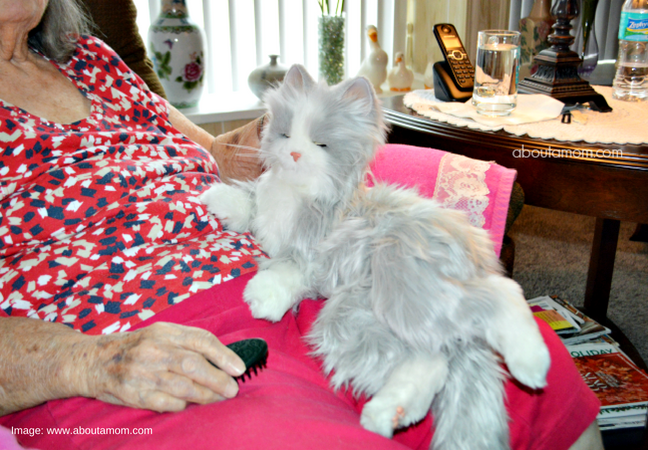
Elders with declining cognitive function tend to love the companion pets, while seniors with more intact mental facilities are often overly aware of the pets' robotic natures. Although research is not even so conclusive on whether the benefits of robotic therapy pets are lasting, at that place are many example studies that affirm the product's ability to soothe the agitation and anxiety that ofttimes accompanies conditions in one-time historic period. For many seniors, it's their only chance to exist in a caregiver part, giving them a much-needed sense of empowerment. Joy for All Companion Pets are all-time for seniors with a limited budget who suffer from memory and cerebral impairments that cause from anxiety, low, and agitation.
AIST's PARO
PARO was adult by the Intelligent System Research Found of Japan's AIST, a pioneer in industrial automation. It was introduced in Japan and Europe in 2003 and went on sale in the United States in 2008 for $6,000, although the sales office offers a brusk-term trial rental plan for prospective buyers. PARO is another robotic therapy pet that resembles a big-eyed white baby harp seal. Like the Joy for All Companion Pets, PARO was specially designed to soothe people with Alzheimer's illness and dementia. PARO has v kinds of sensors: tactile, low-cal, audition, temperature, and posture to perceive and respond to a user's behaviors. The seal moves, cuddles, blinks its optics, makes fun noises, and flaps its flippers. PARO is built to actively seek eye contact, think faces, and learn actions that generate a favorable reaction in its users.
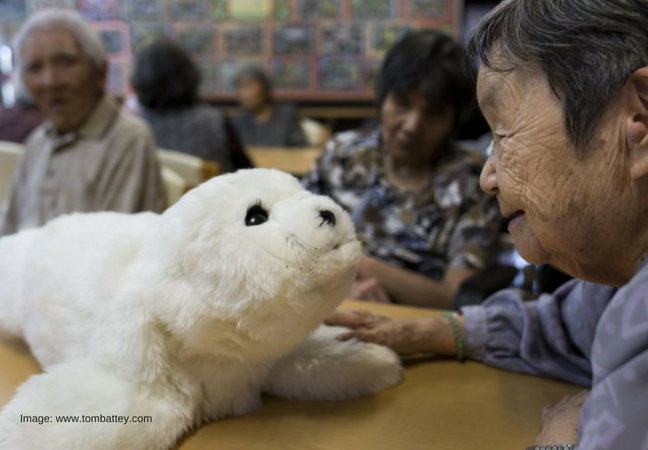
PARO not only responds to touch and sounds, but it tin also learn names, including its ain. The therapy pet is active during the day and sleeps at night. In Japan, more than 1,300 Paros have been sold since 2005, 70% to individual users as substitutes for alive pets. So far in the U.Due south., PARO has been primarily used in long-term intendance facilities. Information technology'south not a great selection for those with a express budget, but if your loved one lives in a facility, you could talk to the staff nearly including PARO in their delivery of care.
Omron's NeCoRo
NeCoRo is a robot that resembles and acts like a real cat. There's a striped gray and a striped orange model and it retails for $one,530. Though NeCoRo doesn't respond to commands or perform tricks, NeCoRo purrs when stroked, perks up its ears, squints it eyes, tilts its caput, and stretch its legs to express a range of feelings like sleepiness and surprise. NeCoRo has 15 moving parts, making it more than mobile than PARO and Joy for All Companion Pets while still limiting its motions to a user's lap or a level surface. It can sit, stand up, lay down, stretch, paw at toys, and wash its face. It responds to it's users touch with cuddly emotional feedback and 48 different feline sounds.

NeCoRo has tactile sensors behind and beneath its ears and on its backs, mimicking the spots that are nearly sensitive in real cats. Its fake fur expands and contracts with its body movements and expressions. Audio and visual sensors allow it to recognize its name, loud noises, and sudden movements. It develops personality traits based on its owner's treatment. NeCoRo is a good option for seniors who want a more life-similar, engaging robotic pet. While they run a steeper rate, they may be more suitable for seniors who retain greater cerebral facilities than the Joy for All Companion Pets or PARO.
Social and Wellness Intendance Robots
Catalia'due south Mabu Personal Health Companion
Mabu Personal Health Companion takes a far different approach than the pet therapy models, focusing on comprehensive care rather than physical comfort. Currently, Mabu is merely available in ongoing programs through healthcare providers and the cost of buying depends on the healthcare provider. It has a pocket-size humanoid form about the size of a coffee pot that holds an interactive tablet in its hands. Mabu's cartoonish form speaks and listens to its user. It'due south designed to serve as a health care coach, as a way to stay in bear upon with medico'southward offices and pharmacies, and as a companion to prevent loneliness.

Mabu is designed peculiarly for patients who struggle with the challenges of chronic affliction management. The intelligent, socially interactive robot tailors its conversations to each patient to adapt to different personalities and weather. The structure of conversations are based on proven behavioral models of psychology that promote positive behavioral change and encourage a patient'south optimal wellness. Over time, it learns about each user's personality, interests, and treatment challenges and then that its program of intendance can best accommodate the patient's needs.
Mabu is non mobile, simply information technology does make eye contact while carrying on conversations and tin can perform simple gestures with its caput and eyes. The tablet screen that Mabu holds features an interactive affect screen that allows it to convey and receive additional information, and it's paired with mobile devices to provide reminders to users even when they're out of the business firm. Information technology provides existent-time data, feedback, and communication between health providers and patients to continually assess and improve its wellness care delivery. Check with your loved one'south health care provider to see if Mabu'south available. It's best for seniors who need to focus on health care needs and coordinate a complicated plan for treatment and intendance.
Care.bus'south GeriJoy
GeriJoy has the least robotic form of the agglomeration, with a tablet screen mounted on a small, rotating stand. It can be purchased with a thirty day take a chance-gratis trial, after which it costs $249 per month. Users tin can choose from a puppy or a kitten avatar that is controlled by a trained staff member. Sound and video are streamed to a live GeriJoy Caregiver who replies using specially-congenital technology.

Through the avatar, human caregivers provide personalized, 24/7 emotional back up and real, stimulating social interactions. GeriJoy Caregivers typically check in on a user iv times an hour, merely GeriJoy tin can also interact with the user apart from the homo Caregiver. The avatar animations are designed to be beautiful and engaging, to heave user mood and cocky-esteem, and to respond to a user's feelings. For case, if a user seems nostalgic, the avatar can testify them a slideshow of their favorite people and places from the past.
GeriJoy encourages healthy beliefs, reminding users to take medications, practise, eat breakfast, and drink more water. GeriJoy records its user's conversations, enabling the Caregiver'southward to always remember details virtually the senior'due south life, like the names of grandchildren and favorite TV shows. Health data is sent to a clinician on a weekly ground, resulting in improved wellness outcomes and reduced hospital conversations. If a GeriJoy Helper notices a problem, it can speak to the user, alert a family member, or call for assistance. Each calendar week, the GeriJoy Caregiver summarizes their conversations to the user's family.

Additionally, family unit members can admission their loved ane'southward daily logs via the Family Portal at any fourth dimension to upload photos and updates and bank check in on their loved ane's emotional and physical health. GeriJoy models are best for seniors who can bear on exact conversations. For the hearing impaired, the avatar can display captions. Information technology's a great choice for older adults who need interesting and varied conversations and for families who worry about their loved ones but are unable to physically check in on them equally frequently equally they'd like.
Intuition Robotic'southward ElliQ
ElliQ is designed to help the elderly remain agile, independent, and engaged. Information technology'southward manufactured by the Israeli startup visitor Intuition Robotics and isn't nonetheless on the market but is likely to warrant a high toll tag. The robot looks more like a lamp that sits on a table than a human. Its blueprint was inspired by the animation lamp in Pixar's logo.

It has two parts: ElliQ, the "social managing director" that speaks with a female vocalism and strives to emulate human characteristics, and the accompanying interactive tablet that displays content to the user. The model uses "body language," voice, sound, and calorie-free to convey emotions and information with the users. The model improves over time, using machine learning to adapt to an possessor's needs. Elder users can play games, access social media, and conduct video chats on the screen to remain continued to the outside world. ElliQ can propose music, podcasts, or audiobooks that the user might enjoy and can also recommend health activities like taking a walk when the user has been engaged in a sedentary action for a long period of fourth dimension.
ElliQ will initiate a conversation as it notes user activity around the house. It tin can also ease conversations between generations by reading texts out loud and enabling family members to check-in on a daily basis. ElliQ stays on pinnacle of a user'southward appointments and medications but while it's design may remind consumers of an Amazon Echo, information technology provides far more mental and emotional stimulation. When ElliQ goes on sale, information technology will be a good option for isolated elders with a substantial budget who prefer a less humanoid, more reckoner-like platform.
Jibo, Inc.'s Jibo
Jibo is a social robot for the domicile that looks, listens, and learns. Jibo currently retails for $899. Like ElliQ, the model resembles more than of a lamp than a person. It features a big, circular screen that's rounded in the back and mounted on a curved white stand up. Information technology's almost one foot tall, weighs six pounds, and is wirelessly connected to the internet. Information technology rotates around its axis, has congenital in panoramic cameras that can scan and photograph the room, has 360-degree microphone capabilities, and an interactive bear upon screen.

Jibo can deliver a personal report each morning time that includes the weather, the news headlines, traffic information, and appointments. It's built with avant-garde facial and phonation technology to allow it to develop personal relationships with xvi unlike people. It has a friendly, youthful, and fun personality and graphics on the screen prove animated expressions. Jibo loves to dance, make suggestions, tell jokes, offer helpful advice, play music, and just conversation. It can provide health reminders for appointments, medications, and fitness.
With the Jibo Commander App, users can command Jibo on their phone no matter where they are. They tin can customize its dialogue, choreograph its movements, or create a personalize display message for different individuals. Jibo is best for seniors who have playful personalities, demand social support and love, and desire to exist connected to a large group of family and friends.
Mobile Robots
AvatarMind's iPal
iPal is one of the more humanoid robotic caregiving devices on the market place, designed for both children and elderly people to serve as a social companion, educator, and rubber monitor. The device costs $2499 for the standard version and $9999 for customized business concern versions. The fully mobile robot has legs that are mounted to wheels that enable it to motion around the house. It tin sing, dance, carry on conversations, and provide basic services. Information technology has a broad range of motion in its arms and neck, built-in obstruction abstention software, and a depression center of gravity that increases its stability. It's 3.five feet tall, 27.5 pounds, and comes equipped with a built-in camera, 5 microphones and WiFi/Bluetooth capability.

These technologies enable the robot to record video and audio that can assistance clinicians and family members provide the user with the all-time back up. Family members can keep an heart on their loved one from another room or outside the dwelling and can even interact with their loved one remotely through iPal.
iPal delivers medication reminders and other health services and similar other health care robots, the iPal volition alert emergency services in the case of a problem. Information technology uses the Android operating system, which makes it able to run standard Android apps on the screen on its chest. A few tactile sensors are even included to sense concrete interaction. iPal'due south are all-time for seniors who need more than just conversation, but entertainment, connection, and care.
Softbank'due south Pepper
Pepper was introduced past the Japanese telecom giant Softbank in 2014 to provide a range of services from caregiving to business assistance. Pepper's some other humanoid-looking robot, but unlike iPal, its platform is run by a deject-based AI organisation. It currently retails for $1600, with $360 monthly subscription rates over a 3-year period. It connects to Softbank's network to share and gather data from users and enable robots to larn from each other.

Pepper is child-height with mobile arm and head joints and a rolling platform. Pepper is emotionally intelligent, expressing emotions modeled on the sensory inputs that generate human behavior. It is designed to clarify a user'due south gestures, tone of voice, and expressions in lodge to adapt its behavior to a given situation.
Pepper can also generate emotions autonomously past processing information from its cameras, touch sensors, accelerometer, and other sensors within its multi-layer neural network. The device can recognize faces and voices, acquire almost tastes and habits, and be personalized by downloading software applications that can fit a user'south mood or a specific occasion. Pepper is not currently offered for domestic utilize, although it's designed to bring joy to people's lives and heighten relationships. Currently Pepper's but being used in offices, banks, medical facilities, and research institutions in Japan. Mayhap one twenty-four hours information technology volition be available for domicile use, in which case it would exist all-time for seniors with a substantial upkeep and a serious need for companionship and a loftier caste of emotional intelligence.
Moin Robotics Care-O-Bot four
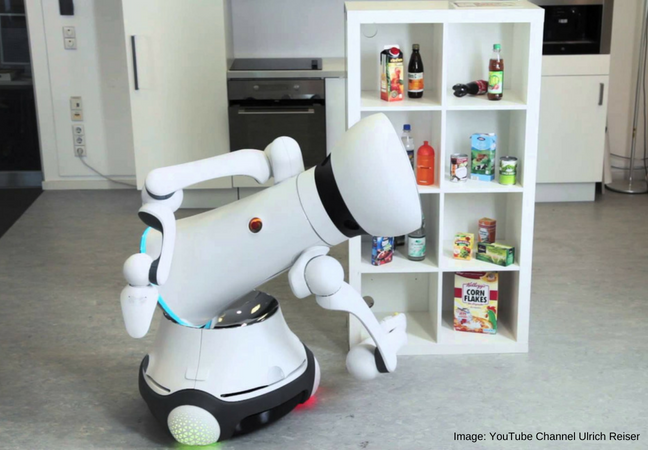
Moin'south Care-O-Bot iv is a mobile robot assistant that tin actively help seniors in their daily lives. The new model has been updated with improved social interactions, mobility, and customizability. It was designed to be an affordable caregiving option, with six configurable plug and play models that allow a user to scale the model to a user's needs and budget. Currently, no price information is available and it's not for public sale in the Us. Information technology has a vaguely humanoid shape, with an upwardly-tilted round caput, arms, grasping hands, a tray, and a rolling base. Information technology has the greatest physical capabilities of any of the robotic models reviewed and can perform a range of household tasks such as delivering nutrient, drinks, and medications to the user and profitable in cooking and cleaning.
Its customizable nature allows users to choose from a multifariousness of capabilities. For instance, the model tin can feature machine-similar movements or motion in all directions with 31 degrees of freedom. The torso and caput joint can be fixed, they can be pan joints that can turn around the base, or they can exist spherical joints that allow movement effectually all axes. It can take zilch, 1, or ii artillery and the sensors can be configured to perceive a range of sensitivities. Currently, Intendance-O-Bots take been successfully used in German language assisted-living facilities, where they provide health intendance, companionship, and cognitive stimulation. It can also place emergency calls, host video conferences, and engage in conversations.

Information technology features multimodal user input including a touchscreen on its face, microphones, and speakers. Cameras on its face allow it to customize its behavior based on gesture recognition and the graphical user interface. A Intendance-O-Bot tin can express itself through LEDs, sounds, text-to-speech, a laser pointer, and body gestures. It's built on an open-source operating system that allows it to constantly exist modified and improved. When Care-O-Bots become available, it volition exist best for seniors who want to remain independent only demand high levels of support and companionship, for seniors who lack mobility, and for seniors who have a hefty notwithstanding flexible upkeep to spend on home care.
Blue Frog Robotic's BUDDY
Buddy is an open-source robotic companion that has been funded past an Indiegogo entrada. Though it disappeared from the market for several years, a new and improved version is soon to striking to be released. Preordering has ended but it'due south expected to be bachelor to the public within the next year at a retail toll of $649. Like the Care-O-Bot, it features a number of modules that tin be customized to adjust a user'south preferences.

Information technology has a small dome shaped body that'southward sits on a fully mobile platform with three wheels. Its oblong face displays a range of cartoonish emotions. Buddy provides a variety of services including home protection, social interaction, personal assist, multimedia functions, amusement, calendar reminders, and interactive interfaces. While a user is abroad, BUDDY patrols the home and alerts the user of whatsoever unusual activeness. It features real-time business firm mapping and localization, remote control, autonomous standoff, and obstacle abstention. It connects to all the smart devices in the home, which users tin can so control through BUDDY.
It offers mobile telepresence including connections to Skype and Facetime, photo and video sharing, and social media connection. It tin can help a user set reminders, alarm clocks, and to-do lists and provide them with practical information like weather condition forecasts, recipes, and traffic. It can function equally a storyteller or an interactive teacher. BUDDY can detect falls or unusual activities in an elder and alert emergency services. BUDDY has speech recognition software; home and object detection, recognition, and tracking; and text-to-speech capabilities. When Buddy becomes available, information technology volition be ane of the best options for seniors in providing a huge range of capabilities from healthcare to friendship. Its endearing, mobile, and customizable design arrive the best all-around pick in the bunch.

Conclusion
Caregiver robots still have a long ways to go. Pet therapy robots have already provided comfort and happiness to many seniors worldwide, but robots that are meant to provide health intendance and companionship are still pricey, limited, and new. Family members need to ensure that a robot can be trusted with their loved one, but that may have some more time to prove.
The robots reviewed in this article are some of the best options out there, and although they're non perfect, they could be function of a comprehensive health care plan. Not all seniors volition take to the idea of a robotic companionship, but everyone should at least give one a effort. There are then many options, from robots that connect to actual man caregivers to robots that act more than like personal butlers.
Try to stay up-to-date on the latest caregiver robots that hit the market and discuss the possibility with your elder. In the coming years, it might be the perfect choice. Robots are a great opportunity for seniors who want to live at home but need more assistance than y'all're willing to provide. To stay posted on the latest caregiving technology, subscribe to Ayuda's newsletter!
When a Baby Reads the Expression of a Caregiver
Source: https://medium.com/ayuda-care/will-robots-replace-caregivers-146b630848c6
0 Response to "When a Baby Reads the Expression of a Caregiver"
Post a Comment